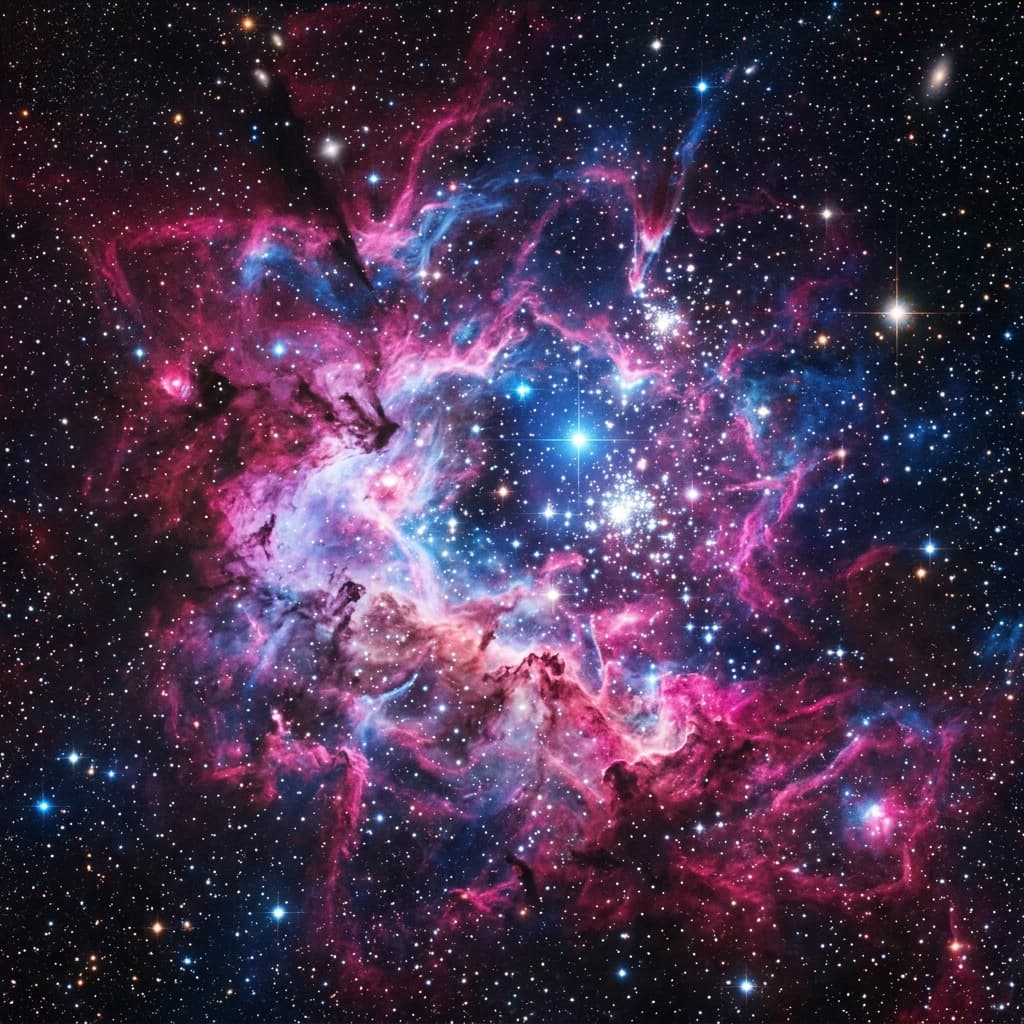
The Orion Nebula
A massive stellar nursery located just 1,344 light-years away. One of the brightest nebulas in the night sky.
Planetary / Mission Telemetry
Historical Context
The Past
The Orion Nebula (Messier 42) has been observed by ancient human civilizations for millennia, visible to the naked eye as a 'fuzzy star' in the middle of Orion's Sword. However, its true nature as an immense, glowing cloud of interstellar gas was only confirmed after the invention of the telescope in the early 17th century. For billions of years, the space that the nebula currently occupies was just a cold, dark, and unimaginably vast molecular cloud. Roughly 3 million years ago, an unknown trigger—perhaps a shockwave from a nearby supernova—caused a dense pocket of this hydrogen gas to collapse under its own gravity. As the gas condensed, it ignited, birthing a massive cluster of incredibly hot, young stars known as the Trapezium Cluster, whose intense radiation illuminated the surrounding cloud.
Live Status
The Present
Today, the Orion Nebula is the closest region of massive star formation to Earth, making it one of the most intensely studied objects in astronomy. It serves as our primary laboratory for understanding how stars and planetary systems form. The fierce ultraviolet radiation pouring out of the massive young stars in the Trapezium Cluster is actively ionizing the surrounding hydrogen gas, causing it to glow brilliantly and carving massive cavities into the cloud. The James Webb Space Telescope recently captured breathtaking, unprecedented images of the nebula, revealing hundreds of 'proplyds'—protoplanetary disks. These are thick, spinning disks of dust and gas surrounding baby stars, which are actively coalescing into new planets, moons, and solar systems right before our eyes.
Future Trajectory
Next Steps
The Orion Nebula is a fleeting, ephemeral structure on a cosmic timescale. Star formation is an incredibly violent and destructive process. Over the next few million years, the intense stellar winds and torrential ultraviolet radiation from the massive newly-formed stars will continue to carve out the nebula, eventually blowing the vast majority of the remaining hydrogen gas completely away. Once the gas is dispersed, star formation will permanently cease. What will be left behind is a tightly bound 'open star cluster'—a group of young, bright stars and their newly minted planetary systems, drifting together through the spiral arms of the Milky Way, similar to the Pleiades cluster we see today.