Earth
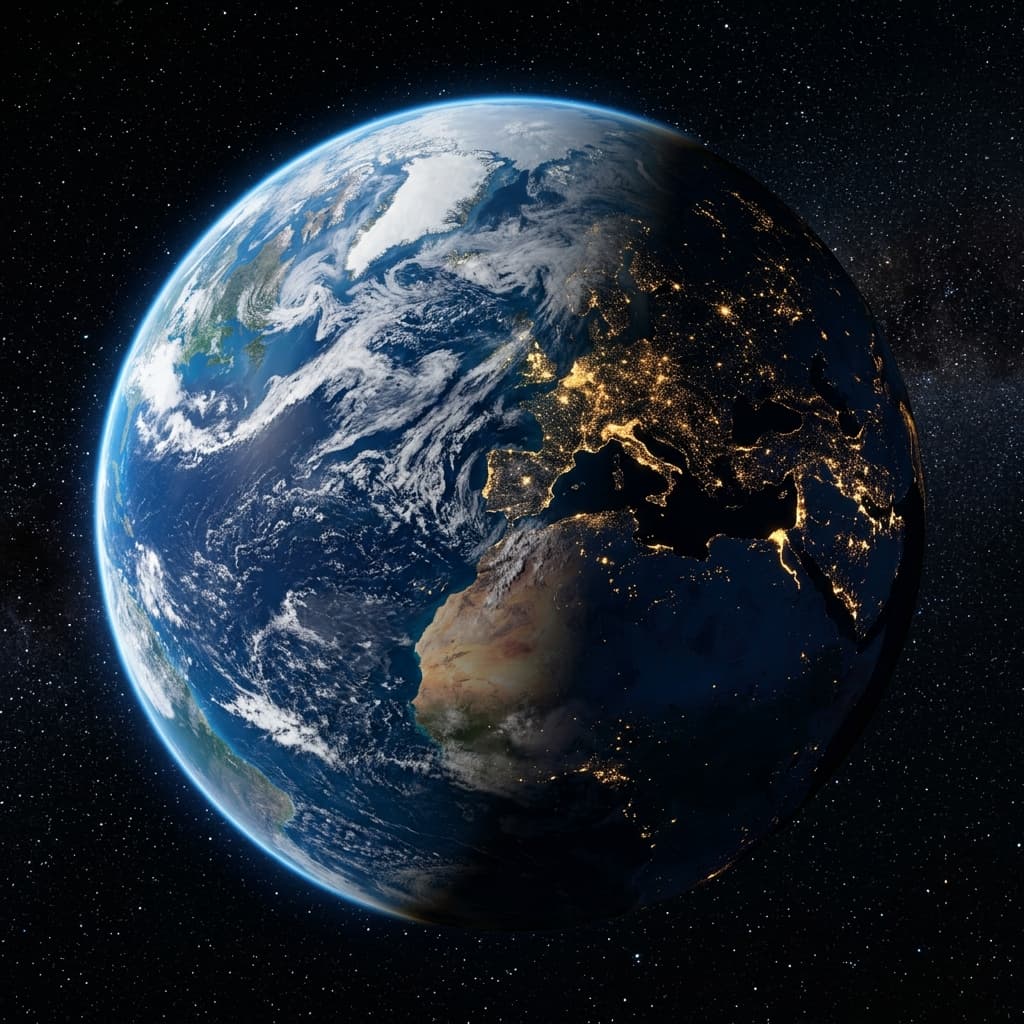
The pale blue dot. The only known world to harbor life, perfectly positioned in the habitable zone.
Planetary / Mission Telemetry
Historical Context
The Past
Earth coalesced from the solar nebula 4.54 billion years ago as a molten sphere of rock. During the Hadean Eon, the surface was a hellscape of active volcanism and frequent asteroid bombardments. As the planet cooled, water vapor condensed into vast oceans. Around 3.5 to 3.8 billion years ago, deep within the hydrothermal vents of these primordial oceans, simple single-celled life arose. Over billions of years, cyanobacteria developed photosynthesis, triggering the Great Oxidation Event, which fundamentally altered the atmosphere by filling it with oxygen. This paved the way for complex multicellular life. The planet has survived five major mass extinctions, the most famous being the Chicxulub asteroid impact 66 million years ago, which annihilated the non-avian dinosaurs and allowed mammals to ascend to dominance.
Live Status
The Present
Earth is the ultimate anomaly in the known universe—a pale blue dot teeming with life. It possesses a powerful magnetic field generated by a spinning liquid iron core, which acts as an invisible shield against deadly solar radiation and cosmic rays. Its atmosphere is a perfect, breathable mixture of 78% nitrogen and 21% oxygen. The surface is continuously recycled by the slow, grinding movement of tectonic plates, which regulates the long-term carbon cycle and stabilizes the climate. Currently, the dominant species—Homo sapiens—has established a globally connected, highly technological civilization. However, this rapid industrialization has triggered severe anthropogenic climate change, rapidly increasing greenhouse gas concentrations and pushing the biosphere toward a potential sixth mass extinction.
Future Trajectory
Next Steps
The future of Earth is entirely dependent on humanity's ability to navigate the critical bottleneck of the 21st century. In the short term, massive global efforts are required to transition to renewable energy (solar, wind, fusion) to stabilize the climate and prevent catastrophic ecological collapse. In the long term, over hundreds of millions of years, the Sun will slowly increase in luminosity. Roughly 1 billion years from now, the Sun will be so hot that Earth's oceans will begin to boil, triggering a runaway greenhouse effect similar to Venus. To survive this inevitable cosmic destiny, humanity must become a multi-planetary species, establishing self-sustaining colonies on Mars and perhaps the moons of the outer gas giants, ensuring the light of consciousness survives the death of our homeworld.