Jupiter
The King of Planets. A massive gas giant that protects the inner planets by catching asteroids.
Planetary / Mission Telemetry
Historical Context
The Past
Jupiter was the first planet to form in our Solar System, coalescing from the leftover gas and dust shortly after the Sun ignited. It acts as the gravity anchor of the entire system. According to the Grand Tack Hypothesis, the young Jupiter migrated inward toward the Sun, sweeping up debris and shaping the formation of the inner rocky planets, before being pulled back to its current orbit by the gravitational influence of Saturn. Jupiter is so massive—more than twice as massive as all the other planets combined—that it fundamentally dictated the architecture of the Solar System. If it had been about 80 times more massive, the immense pressure and heat in its core would have triggered nuclear fusion, turning it into a second star.
Live Status
The Present
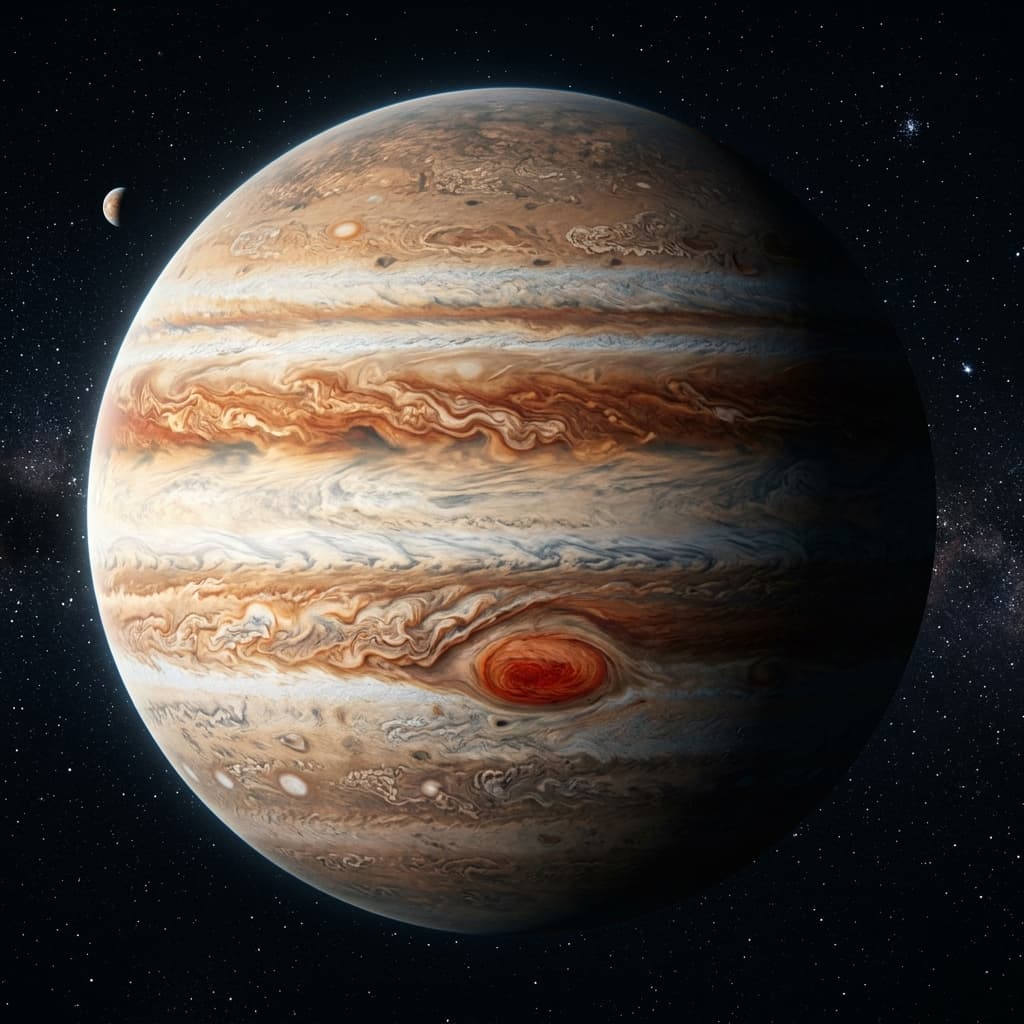
Jupiter is a swirling, chaotic sphere of hydrogen and helium gas with no solid surface. Its atmosphere is a violent painting of turbulent cloud bands driven by incredibly fast jet streams and intense Coriolis forces. The most famous feature is the Great Red Spot, a gargantuan anticyclonic storm larger than Earth that has been raging for over 300 years. Deep beneath the crushing atmosphere, the pressure is so intense that hydrogen gas is squeezed into a liquid metallic state, conducting electricity and generating the most powerful planetary magnetic field in the solar system. NASA's Juno spacecraft is currently executing highly elliptical orbits, diving dangerously close to the cloud tops to map this magnetic field and measure the amount of water in the deep atmosphere.
Future Trajectory
Next Steps
The future of Jovian exploration is entirely focused on its massive Galilean moons, specifically Europa and Ganymede. Beneath the miles-thick, radiation-blasted ice crust of Europa lies a global, liquid saltwater ocean containing more than twice the amount of water found on Earth. Hydrothermal vents at the bottom of this alien ocean could provide the energy and chemical nutrients necessary to support extraterrestrial life. NASA's Europa Clipper mission, launching soon, will conduct dozens of low-altitude flybys to scan the ice shell and search for plumes of water erupting into space. Following it, the ESA's JUICE (Jupiter Icy Moons Explorer) mission will arrive in 2031 to study Ganymede, the only moon in the solar system with its own magnetic field.