Mars
The Red Planet. A cold, dusty desert world that was once wet and warm.
Planetary / Mission Telemetry
Historical Context
The Past
Billions of years ago, Mars was a vibrant, dynamic world that looked remarkably similar to early Earth. It possessed a thick, protective atmosphere, a strong global magnetic field, and a relatively warm climate. Geological evidence gathered by orbiters and rovers proves beyond a doubt that vast networks of rivers flowed across its surface, emptying into deep, long-standing lakes and potentially a massive ocean covering its northern hemisphere. The conditions were perfect for the emergence of microbial life. However, roughly 4 billion years ago, the Martian core cooled, shutting down the planetary dynamo. Without a magnetic field to deflect the solar wind, the Sun systematically stripped away the Martian atmosphere. The oceans boiled away or froze underground, transforming the planet into the frozen desert we see today.
Live Status
The Present
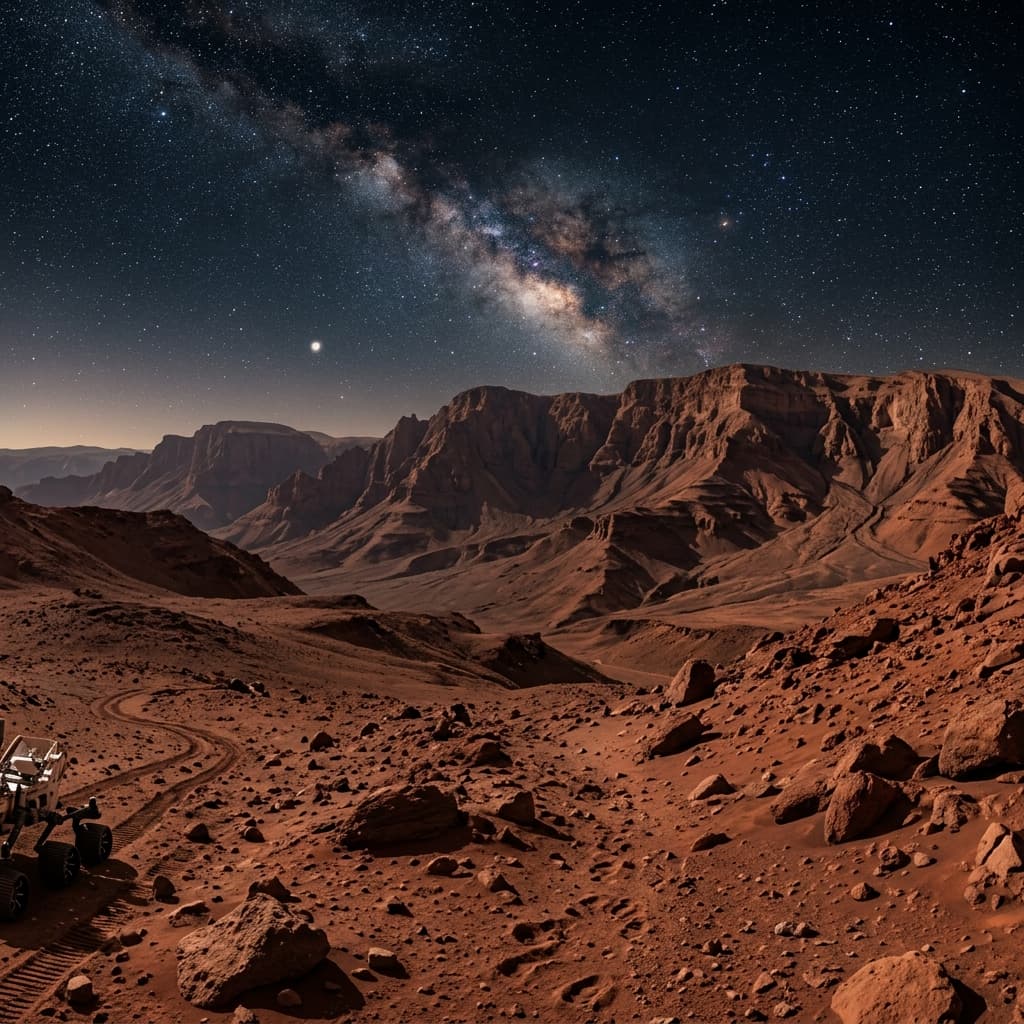
Modern Mars is a freezing, irradiated wasteland covered in toxic, rust-colored iron oxide dust. The atmosphere is 100 times thinner than Earth's and composed almost entirely of carbon dioxide. Despite its desolation, Mars is the most explored planet in the Solar System. It is currently inhabited by a fleet of robotic explorers. NASA's Perseverance and Curiosity rovers are actively driving through ancient, dried-up river deltas, drilling into the sedimentary rock to search for fossilized chemical signatures of ancient alien microbes. High above, orbiters from NASA, the ESA, India (ISRO), and China (CNSA) are mapping the surface in high resolution, discovering massive subsurface glaciers of pure water ice hidden just beneath the dirt at the mid-latitudes.
Future Trajectory
Next Steps
Mars represents the ultimate frontier and the key to humanity's long-term survival. SpaceX, founded by Elon Musk, is dedicating its entire existence to building a self-sustaining city of one million people on Mars within our lifetimes. They are currently testing Starship, a fully reusable, massive launch vehicle designed to carry 100 colonists at a time. The first crewed missions, expected in the late 2030s or 2040s, will focus on establishing a basic propellant plant to generate methane rocket fuel from the Martian atmosphere and ice. Decades later, humanity may attempt terraforming—the theoretical process of intentionally releasing greenhouse gases to warm the planet, melt the polar ice caps, and thicken the atmosphere to make the surface habitable once again.