Mercury
The smallest and innermost planet. A cratered, desolate world of extreme temperature swings.
Planetary / Mission Telemetry
Historical Context
The Past
Mercury formed roughly 4.5 billion years ago in the hottest, most violent region of the early solar nebula. According to the Giant Impact Hypothesis, the young proto-Mercury was originally much larger, similar to Earth or Venus. However, it suffered a catastrophic collision with a massive planetesimal. This apocalyptic impact blasted away the majority of its original rocky mantle and crust, which were then either absorbed by the Sun or blown outward. What remained was essentially the planetary core—a massive, dense sphere of metallic iron that makes up nearly 85% of the planet's radius today. Following this impact, the planet rapidly cooled, causing its iron core to shrink and literally crumpling the rocky surface, forming massive fault scarps (cliffs) that run for hundreds of miles across the landscape.
Live Status
The Present
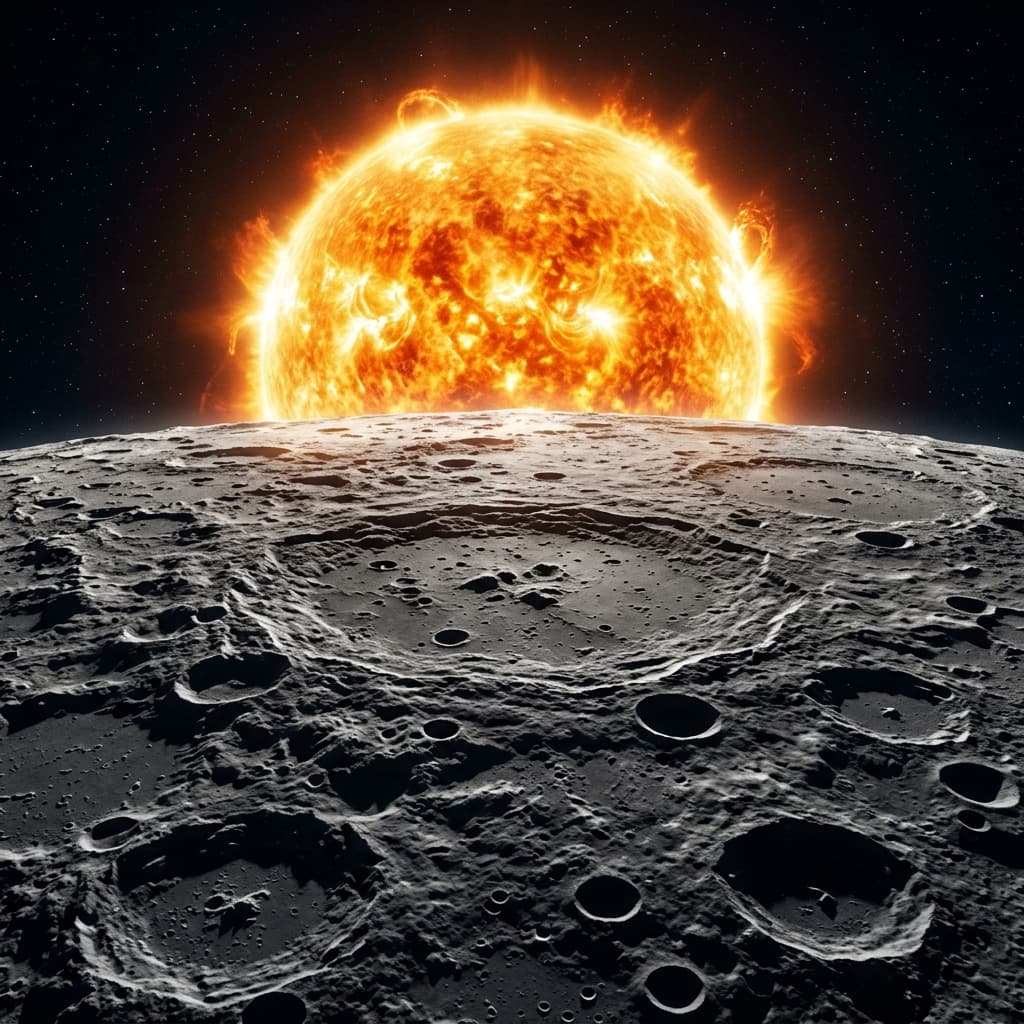
Today, Mercury is a geologically dead, heavily cratered world that bears a striking resemblance to Earth's Moon. Because it lacks a substantial atmosphere to trap heat, it experiences the most extreme temperature fluctuations in the entire Solar System. During the long, brutal day, surface temperatures soar to 800°F (430°C), hot enough to melt lead. But as night falls, the heat instantly radiates away into space, plunging temperatures down to a bone-chilling -290°F (-180°C). Despite these extremes, NASA's MESSENGER spacecraft made a shocking discovery in 2012: deep inside permanently shadowed craters at Mercury's north and south poles, there are massive deposits of pure water ice. This ice was likely delivered by comet impacts billions of years ago and has remained frozen in the perpetual darkness.
Future Trajectory
Next Steps
The future of Mercury exploration relies on the BepiColombo mission, a joint venture between the European Space Agency (ESA) and the Japan Aerospace Exploration Agency (JAXA). Launched in 2018, the dual-spacecraft mission will finally enter Mercury's orbit in late 2025 after a complex seven-year journey involving multiple planetary flybys. BepiColombo will deploy two separate orbiters: the Mercury Planetary Orbiter (MPO) and the Mercury Magnetospheric Orbiter (MMO). Together, they will map the planet's surface in unprecedented multi-wavelength detail, probe the mysterious dynamics of its weak but persistent magnetic field, and investigate the exact composition of the polar ice deposits. This mission aims to definitively answer how a planet so close to its star could form and evolve.