The Moon
Earth's faithful companion, responsible for the tides and stabilizing our planet's wobble.
Planetary / Mission Telemetry
Historical Context
The Past
According to the most widely accepted scientific model, the Giant Impact Hypothesis, the Moon was forged in violence roughly 4.5 billion years ago. A protoplanet the size of Mars, named Theia, collided obliquely with the early Earth. The catastrophic impact obliterated Theia and blasted massive amounts of Earth's crust and mantle into orbit. Over millions of years, this super-heated debris ring coalesced under its own gravity to form the Moon. Because it was born so close to Earth, Earth's immense gravity forced the Moon into a tidally locked orbit, ensuring that the same side (the 'near side') always faces our planet. For billions of years, the Moon was heavily bombarded by asteroids, creating the vast dark plains of solidified basaltic lava known as 'maria' that we see as the 'Man in the Moon'.
Live Status
The Present
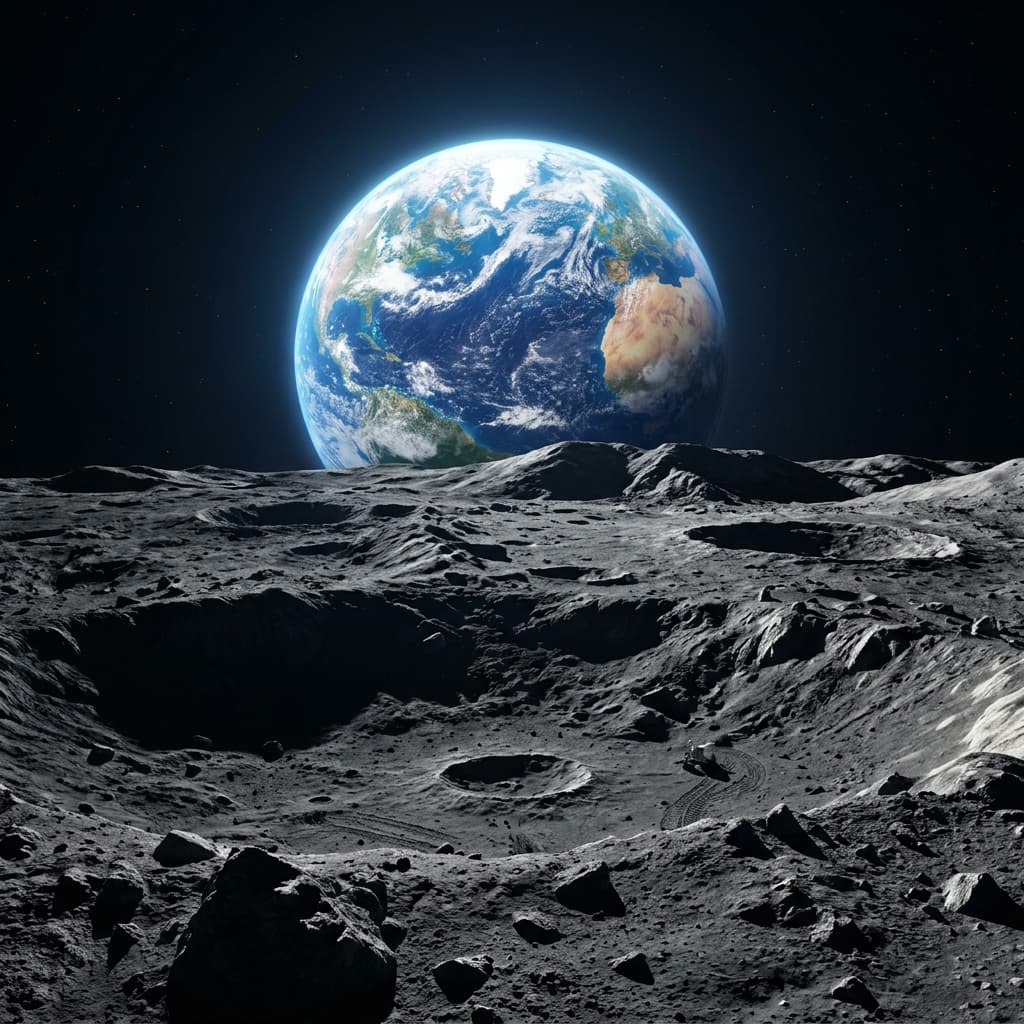
Today, the Moon is a geologically dead, silent world. It has no atmosphere, no liquid water, no active volcanoes, and no magnetic field. The surface is covered in a thick layer of fine, razor-sharp gray dust called lunar regolith, created by billions of years of micrometeorite impacts pulverizing the rock. In 1969, NASA's Apollo 11 mission made history when Neil Armstrong and Buzz Aldrin became the first humans to walk on its surface. Six Apollo missions landed a total of 12 men on the Moon, returning 842 pounds of lunar rocks that fundamentally changed our understanding of planetary formation. Recently, orbiters have confirmed the presence of millions of tons of water ice hidden deep within the permanently shadowed craters of the lunar South Pole.
Future Trajectory
Next Steps
The Moon is about to become humanity's first deep-space outpost. NASA's Artemis Program is actively working to return humans to the lunar surface before the end of the 2020s. Unlike the brief 'flags and footprints' missions of the Apollo era, Artemis aims to establish a permanent, sustainable human presence. The plan involves building the Lunar Gateway—a small space station in orbit around the Moon—and a permanent Base Camp at the Lunar South Pole. This location was chosen because the massive deposits of water ice can be mined and split into hydrogen and oxygen to create breathable air, drinking water, and, crucially, rocket fuel. The Moon will serve as the ultimate proving ground for the technologies required to send humans to Mars.