Neptune
The Windy Planet. A dark, cold, and supersonic ice giant at the edge of the solar system.
Planetary / Mission Telemetry
Historical Context
The Past
Neptune is unique in that it was the first planet located through mathematical prediction rather than empirical observation. In the 1840s, astronomers noticed that the orbit of Uranus was deviating from the laws of Newtonian gravity, suggesting a massive, unseen object was pulling on it. Urbain Le Verrier calculated the exact position of this ghost planet, and it was discovered via telescope precisely where he predicted. Early in the solar system's history, Neptune likely formed much closer to the Sun. Over millions of years, it migrated outward. As it pushed its way into the outer darkness, its massive gravity scattered a colossal disk of icy debris, throwing comets and dwarf planets outward to create the vast, ring-shaped region known today as the Kuiper Belt.
Live Status
The Present
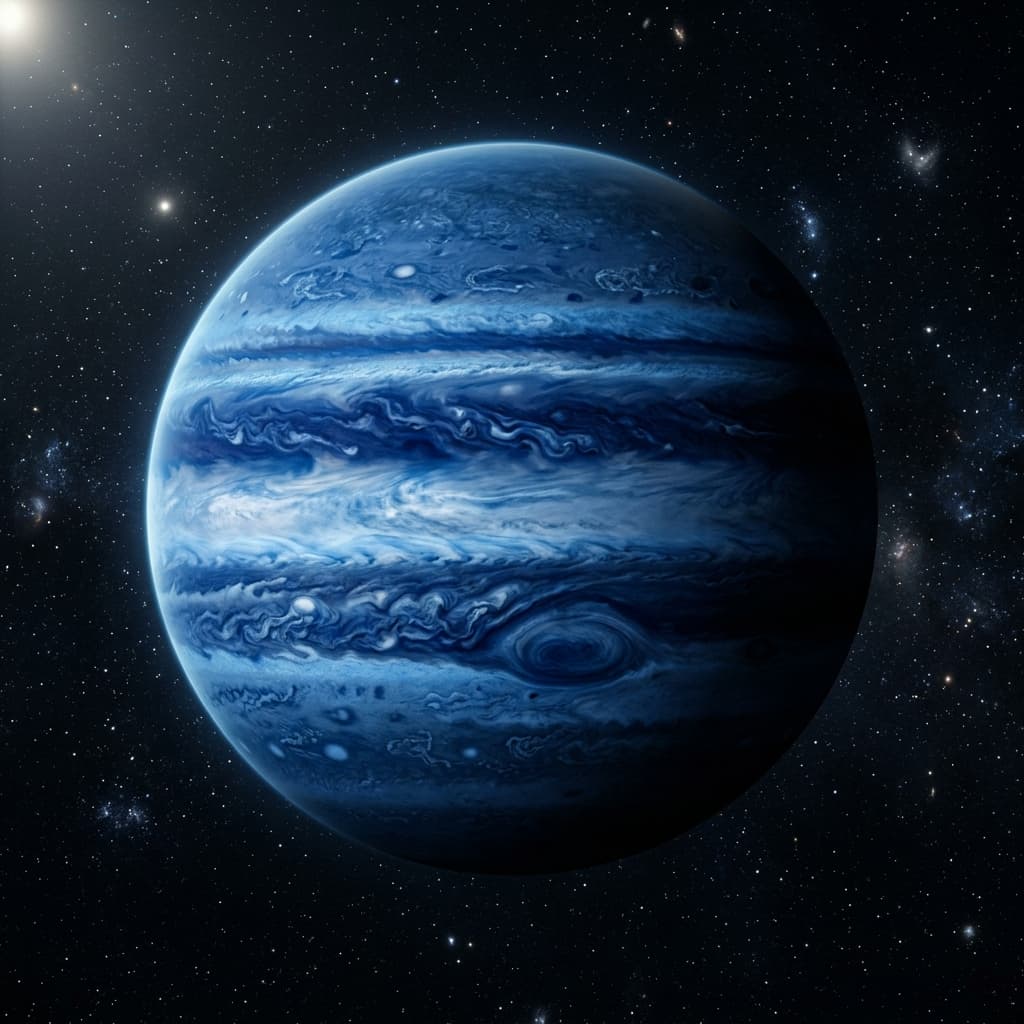
Neptune is a deep, vivid azure blue world located 30 times further from the Sun than Earth. Despite being incredibly cold and far from any solar heat, it possesses the most dynamic and violent weather in the Solar System. Supersonic winds whip through the upper atmosphere at speeds exceeding 1,200 mph (2,000 km/h)—faster than the speed of sound on Earth. Like Uranus, Neptune has only been visited once, by Voyager 2 in 1989. Voyager discovered the 'Great Dark Spot', a massive, spinning storm the size of Earth that has since vanished and reappeared in different locations. Neptune's largest moon, Triton, is a bizarre world covered in 'cantaloupe terrain'. It orbits Neptune backwards (retrograde), proving that it is actually a massive Kuiper Belt object that Neptune's gravity captured billions of years ago.
Future Trajectory
Next Steps
Because Kepler telescope data reveals that 'Ice Giants' like Neptune and Uranus are the most common type of exoplanet in the galaxy, scientists are desperate to understand how they work. While a Uranus orbiter is currently the top priority, a Neptune flagship mission is highly desired for the 2040s. A dedicated Neptune orbiter would study the internal heat source driving its supersonic winds. Furthermore, it would extensively study Triton. Because Triton is slowly spiraling inward due to tidal friction, it will eventually be torn apart by Neptune's gravity, forming a magnificent ring system that will rival Saturn's. A future mission could determine if Triton, like Europa, harbors a liquid ocean beneath its frozen nitrogen surface.