
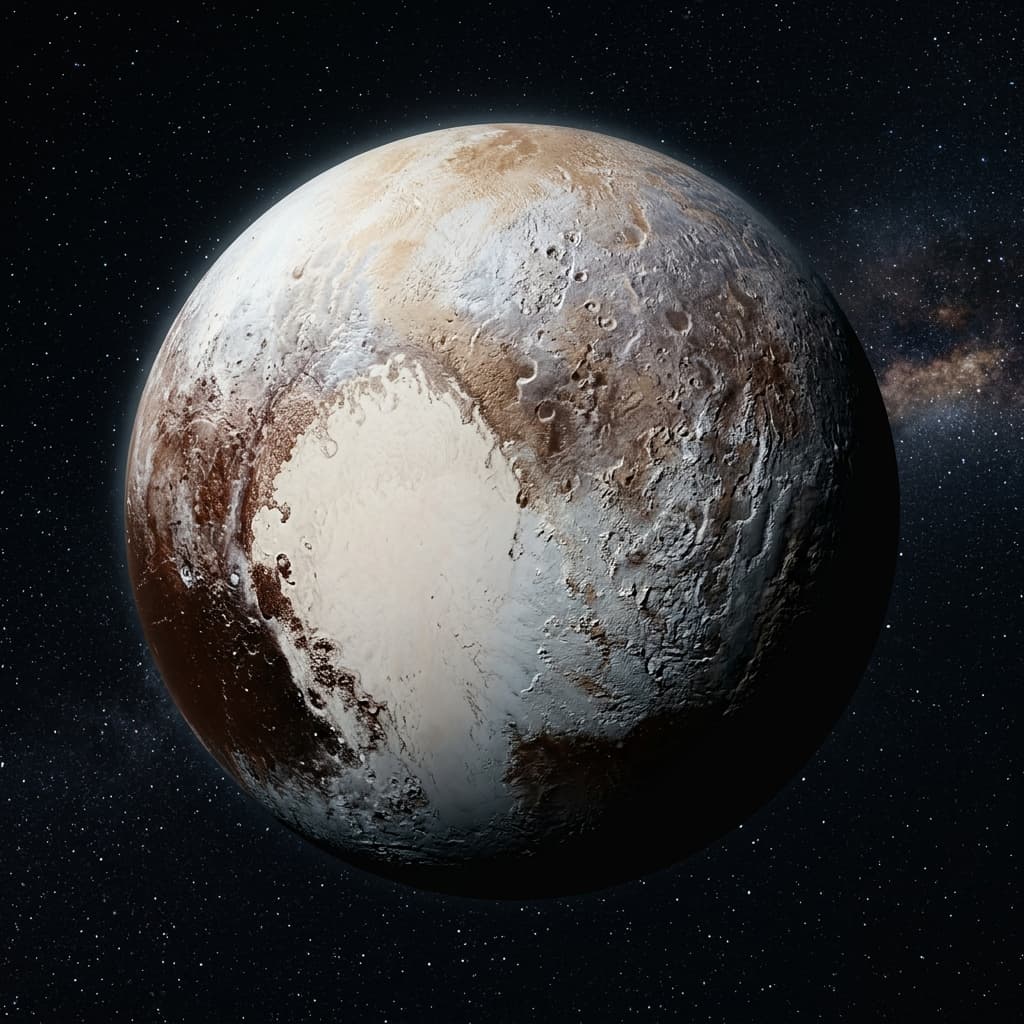
Pluto
The King of the Kuiper Belt. A complex, icy dwarf planet with a giant heart-shaped glacier.
Planetary / Mission Telemetry
Historical Context
The Past
Discovered in 1930 by Clyde Tombaugh, Pluto was considered the 9th planet of the Solar System for 76 years. It was the absolute edge of the known map. However, in the 1990s and early 2000s, improved telescopes began discovering thousands of other icy bodies in the same orbital region, culminating in the discovery of Eris, an object nearly as massive as Pluto. This forced the International Astronomical Union (IAU) to controversially redefine what a planet is in 2006. Because Pluto has not 'cleared its neighborhood' of other debris, it was reclassified as a 'Dwarf Planet' and recognized as the largest and most famous member of the Kuiper Belt—a massive, donut-shaped ring of icy ancient debris left over from the formation of the solar system.
Live Status
The Present
For decades, Pluto was just a blurry pixel in our most powerful telescopes. That changed forever in July 2015 when NASA's New Horizons probe finally flew past Pluto after a 9.5-year journey. The high-resolution images returned by New Horizons shocked the scientific community. Instead of a dead, cratered rock, Pluto was revealed to be a geologically active, breathtakingly beautiful world. It features towering mountains made of solid, rock-hard water ice, and a massive, iconic heart-shaped basin called 'Tombaugh Regio'. The western half of this heart is a sprawling, completely crater-free glacier made of frozen nitrogen that slowly flows and convects, proving that Pluto possesses an internal heat source driving active geology.
Future Trajectory
Next Steps
The New Horizons data is so rich that scientists will be analyzing it for decades. Pluto has fundamentally changed our understanding of small icy worlds. The focus of deep-outer-solar-system astronomy has now shifted. First, astronomers are using the James Webb Space Telescope to analyze the chemical composition of other massive Kuiper Belt Objects (KBOs). Second, a massive hunt is underway for 'Planet Nine'—a hypothetical, undiscovered Neptune-sized planet lurking far beyond Pluto in the Oort Cloud. The gravitational signature of Planet Nine is believed to be responsible for the strange, highly elliptical clustering of distant KBOs. Discovering it would rewrite the textbooks once again.