Saturn
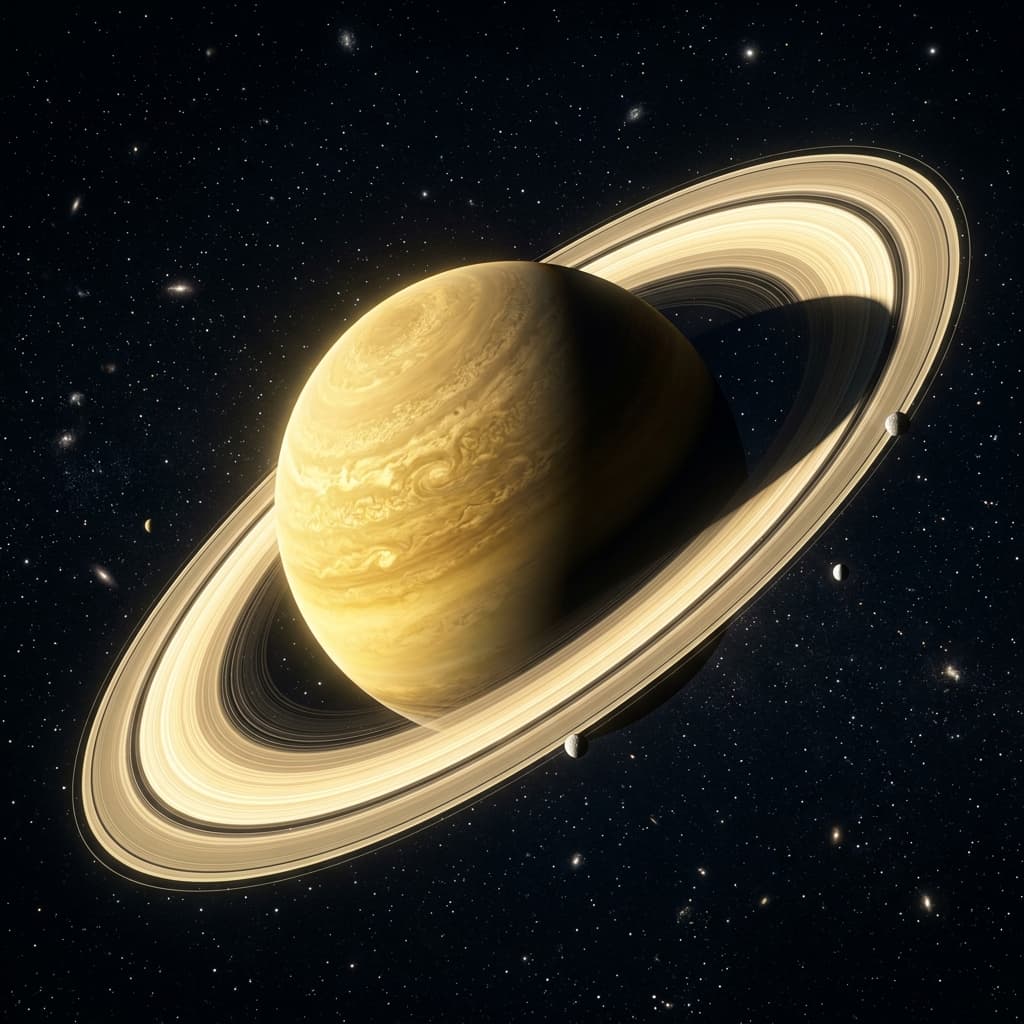
The Jewel of the Solar System, famous for its massive, complex ring system.
Planetary / Mission Telemetry
Historical Context
The Past
Saturn formed in the cold, outer regions of the solar nebula roughly 4.5 billion years ago. Like Jupiter, it is a massive ball of gas and liquid metallic hydrogen, but it is much less dense. In fact, Saturn is the only planet in the Solar System that is less dense than liquid water; if you could find a bathtub large enough, Saturn would literally float. For decades, scientists debated the age of Saturn's iconic ring system. Data from the incredible Cassini mission finally revealed that the rings are likely very young in astronomical terms—perhaps only 10 to 100 million years old. They were likely created when a small, icy moon wandered too close to Saturn and was violently ripped to shreds by the planet's immense tidal forces.
Live Status
The Present
Saturn is a calm-looking, pale yellow gas giant, but its atmosphere hides incredibly fast winds that can reach 1,100 mph (1,800 km/h) at the equator. The Cassini spacecraft, which orbited Saturn for 13 years before intentionally plunging into its atmosphere in 2017, completely revolutionized our understanding of the system. Cassini discovered that Saturn's tiny, icy moon Enceladus is geologically active. Massive geysers at Enceladus's south pole are continuously erupting jets of saltwater, organic molecules, and silica into space, feeding Saturn's E-ring. This discovery instantly made Enceladus one of the most promising places in the entire universe to search for alien microbial life.
Future Trajectory
Next Steps
The next great leap in exploring the Saturnian system is NASA's incredibly ambitious Dragonfly mission. Scheduled to launch in 2028, Dragonfly is a nuclear-powered, dual-quadcopter drone. It will fly through the thick, hazy, nitrogen-rich atmosphere of Saturn's largest moon, Titan. Titan is a bizarre, deeply frozen version of early Earth; it is the only moon with a thick atmosphere, and it has an active weather cycle of rain, rivers, and lakes. However, the liquid is not water—it is liquid methane and ethane. Dragonfly will fly from location to location, landing on the organic sand dunes and icy plains to sample the complex chemistry, searching for the building blocks of life in a deeply alien environment.