Uranus
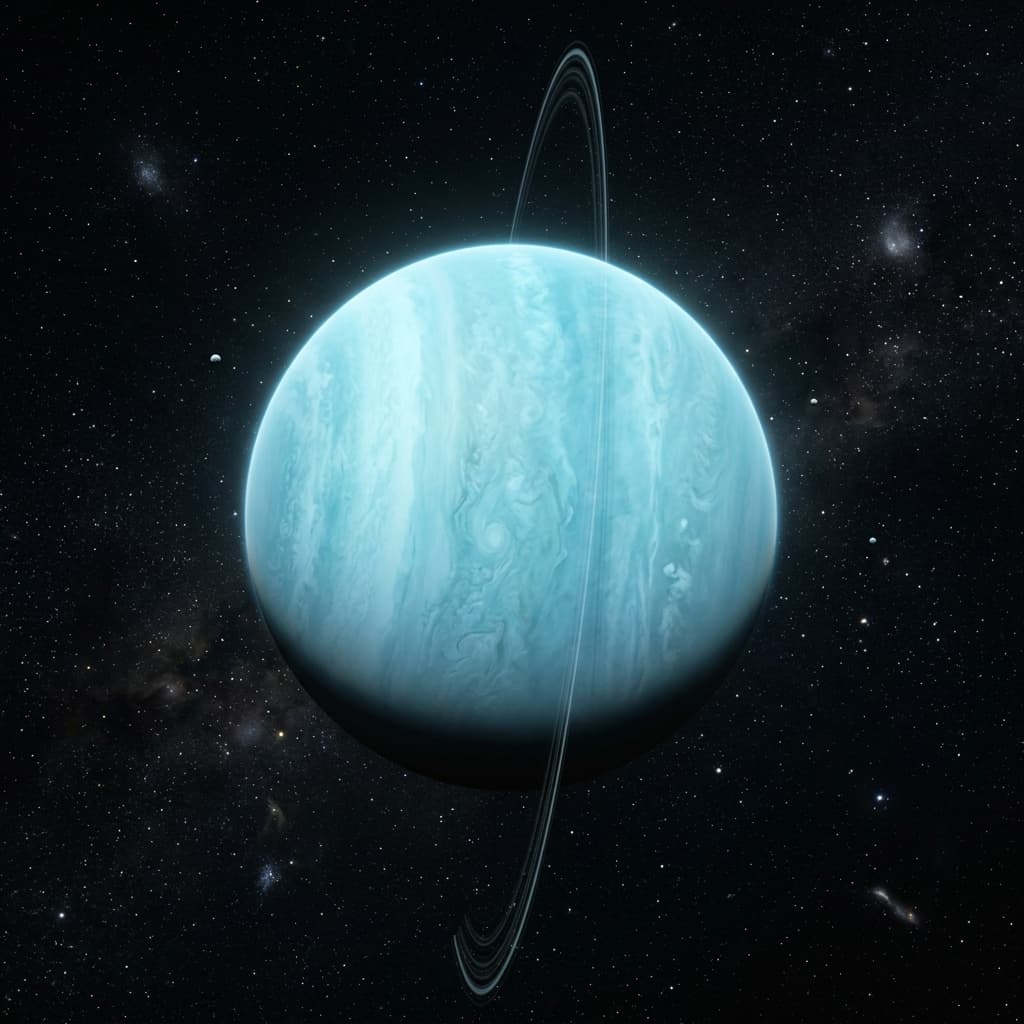
The Sideways Planet. An ice giant rotating on its side, glowing a pale cyan blue.
Planetary / Mission Telemetry
Historical Context
The Past
Uranus was the first planet to be discovered using a telescope, spotted by astronomer William Herschel in 1781. Unlike the gas giants Jupiter and Saturn, Uranus is classified as an 'Ice Giant'. Its interior is composed of a dense fluid 'icy' mantle of water, ammonia, and methane, surrounding a small rocky core. The most defining characteristic of Uranus is its extreme axial tilt of 97.77 degrees. It literally rotates on its side, rolling around the Sun like a bowling ball. Scientists theorize that early in the formation of the solar system, a colossal collision with an Earth-sized protoplanet struck Uranus with unimaginable force, completely knocking the entire planet onto its side and creating its chaotic, off-center magnetic field.
Live Status
The Present
Uranus appears as a featureless, pale cyan-blue sphere, owing its color to the methane gas in its upper atmosphere absorbing red light. It holds the record for the coldest planetary atmosphere in the Solar System, with temperatures dropping to an astonishing -371°F (-224°C). Because of its extreme tilt, Uranus experiences the most extreme seasons of any planet. Each pole gets 42 years of continuous, unbroken sunlight, followed by 42 years of absolute, freezing darkness. The planet has only been visited once in human history, by the Voyager 2 spacecraft during a brief flyby in 1986. Voyager revealed a complex system of 13 faint, dark rings and a collection of icy moons that show signs of deep impact craters and massive, ancient geological fractures.
Future Trajectory
Next Steps
For decades, Uranus has been completely ignored in favor of missions to Mars and Jupiter. However, this is about to change. The prestigious Planetary Science Decadal Survey, released by the National Academies of Sciences, officially designated a flagship 'Uranus Orbiter and Probe' (UOP) as the highest priority new planetary mission for the 2030s. This multi-billion dollar mission would finally return a dedicated spacecraft to the ice giant. It would spend years orbiting Uranus, dropping an atmospheric probe into the cyan clouds to measure wind speeds and chemistry, and conducting deep-dive flybys of its strange, heavily fractured moons like Miranda, which features the tallest cliff face in the known solar system.