Origin Research File
The Big Bang
The Genesis of Spacetime
Deep Lore
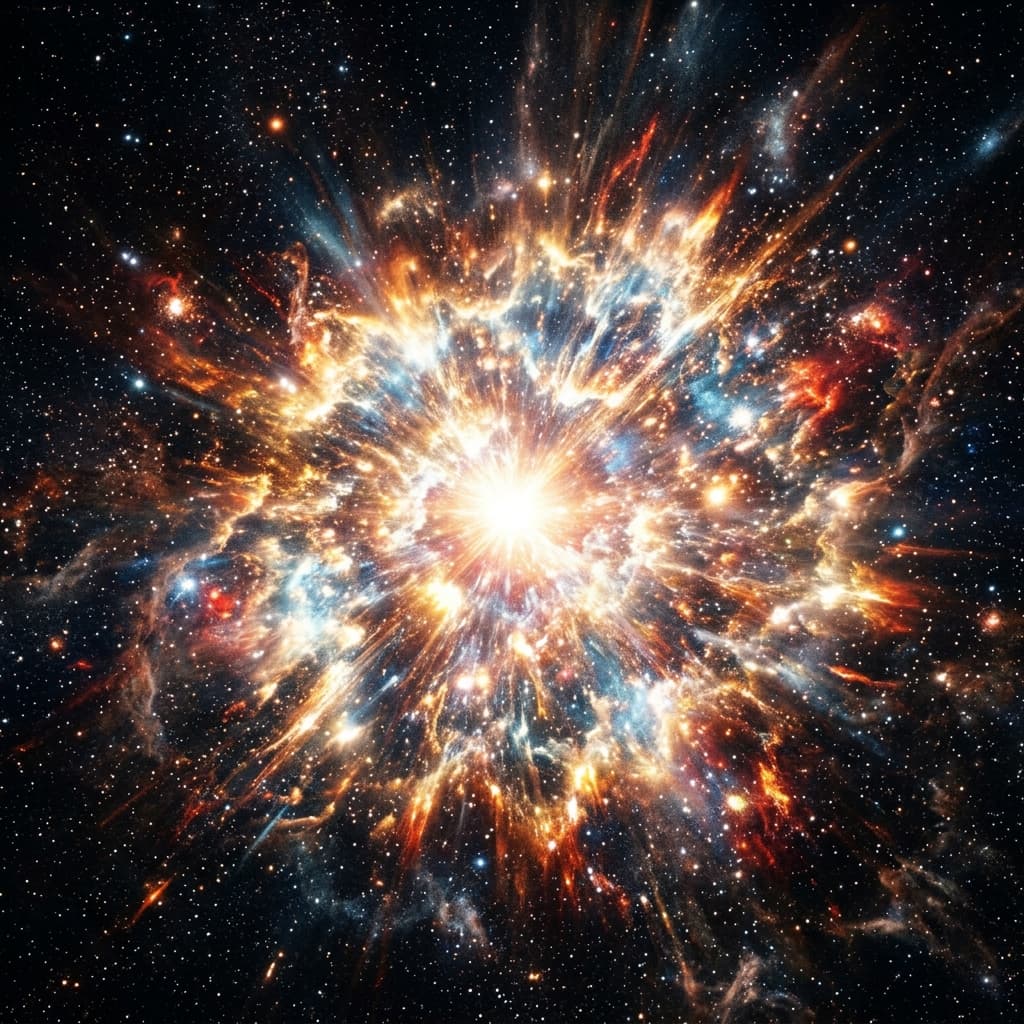
The Big Bang is not an explosion IN space; it is the explosion OF space. Before the Big Bang, there was no space, no time, and no matter. The singularity contained the entire mass-energy of the universe in a state of infinite density and temperature. As it expanded, energy condensed into matter, forming the first subatomic particles, then atoms, then stars, and finally, us.
Physics Mechanics
Cosmic Microwave Background (CMB)
The afterglow of the Big Bang, visible in all directions as faint microwave radiation.
Redshift
As space expands, light from distant galaxies is stretched into longer, redder wavelengths.
Timeline
The Planck Epoch. The laws of physics break down.
Cosmic Inflation expands the universe exponentially.
Recombination. Light is finally free to travel (CMB).
The first stars ignite, ending the Dark Ages.
Core Metrics
Exhaustive Database
The Planck Epoch
The absolute beginning of time. A period so extreme that our current understanding of physics completely breaks down.
Prior to the Planck Epoch, the concepts of space and time simply do not apply. This is the absolute, chronological beginning of the known universe. At the moment of the Big Bang, all the matter and energy that currently exists in the observable universe was compressed into an infinitely dense, infinitely hot point known as a singularity. During the Planck Epoch—which lasted from zero to 10^-43 seconds—the four fundamental forces of nature (gravity, electromagnetism, the strong nuclear force, and the weak nuclear force) were entirely indistinguishable from one another, merged into a single, symmetrical 'Superforce'. The universe was so incredibly hot and dense that the fabric of spacetime itself was violently turbulent and quantum in nature.
Currently, the Planck Epoch represents an absolute, impenetrable wall for modern theoretical physics. We cannot 'see' or mathematically describe what happened during this time because our two most successful and heavily tested scientific theories—General Relativity (which describes massive objects and gravity) and Quantum Mechanics (which describes subatomic particles)—fundamentally contradict each other when applied to the extreme conditions of a singularity. General Relativity predicts infinite density, while Quantum Mechanics demands probability and uncertainty. Because we lack a unified theory of quantum gravity, the physics of the Planck Epoch remains the greatest unsolved mystery in science.
The ultimate goal of modern theoretical physics is to formulate a 'Theory of Everything'—a single, elegant mathematical framework that perfectly unites General Relativity and Quantum Mechanics. String Theory and Loop Quantum Gravity are currently the leading candidates for this grand unification. If humanity ever succeeds in proving a Theory of Everything, we will finally be able to 'peer' mathematically into the Planck Epoch, definitively proving the exact conditions of the Big Bang and perhaps even answering whether our universe is just one of many in a vast multiverse.
Recombination & The CMB
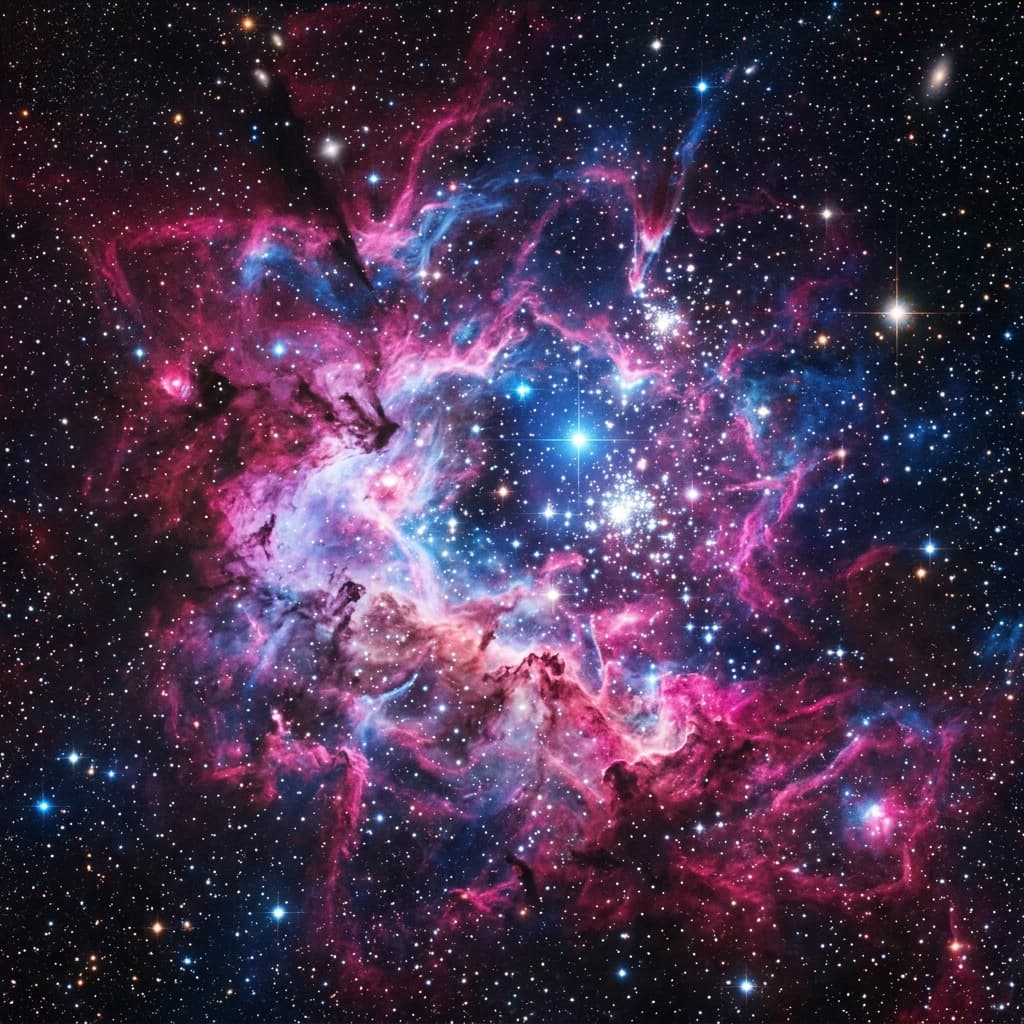
The moment the universe cooled enough for light to travel freely, creating the first flash of light.
For the first 380,000 years after the Big Bang, the universe was an incredibly hot, dense, and opaque plasma composed of free-floating electrons and protons. It was so hot that neutral atoms could not form; any time an electron tried to bind to a proton, a high-energy photon would immediately blast it apart. Because light (photons) was constantly ricocheting off the free electrons, the universe was essentially a glowing, impenetrable fog. Light could not travel freely. However, as the universe continued to expand, it eventually cooled down to a critical threshold of about 3,000 Kelvin. At this moment, known as the Epoch of Recombination, the energy dropped enough for protons and electrons to permanently bind together, forming the very first neutral hydrogen atoms. With the electrons suddenly locked up in atoms, the photons were finally free to travel unimpeded. The universe instantly became transparent, releasing a massive, blinding flash of light that filled all of space simultaneously.
The 'afterglow' of that monumental event is still visible everywhere in the universe today, but it has been stretched significantly by the expansion of spacetime over the last 13.8 billion years. What was originally a blinding flash of visible and ultraviolet light has been stretched into the invisible microwave spectrum. We call this the Cosmic Microwave Background (CMB) radiation. If you tune an old analog television to a dead channel, a small percentage of the static on the screen is actually the CMB—the dying echoes of the Big Bang hitting your antenna. The CMB is the oldest light we can ever possibly see, and it serves as the ultimate baby picture of the universe.
The Cosmic Microwave Background is the most important cosmological tool we have. Dedicated space observatories like the Planck satellite have mapped the CMB in incredible detail, revealing microscopic temperature fluctuations across the sky. These minute temperature differences represent the very first seeds of structure in the universe—regions that were slightly denser and eventually collapsed under gravity to form the first galaxies. Future, highly advanced radio telescopes will continue to study the polarization of the CMB to definitively prove the theory of Cosmic Inflation (the rapid exponential expansion immediately following the Big Bang) and to precisely measure the exact amounts of mysterious Dark Matter and Dark Energy shaping the cosmos.