Recombination & The CMB
The moment the universe cooled enough for light to travel freely, creating the first flash of light.
Planetary / Mission Telemetry
Historical Context
The Past
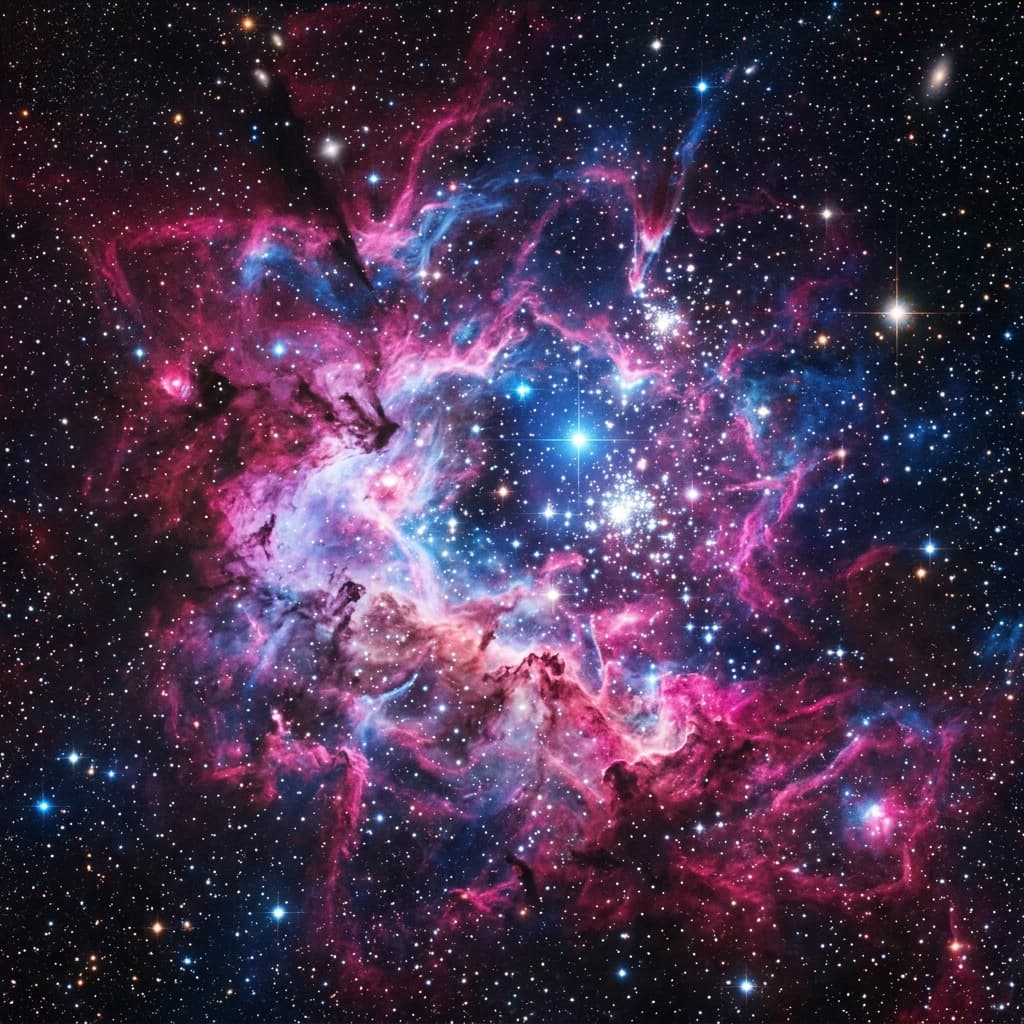
For the first 380,000 years after the Big Bang, the universe was an incredibly hot, dense, and opaque plasma composed of free-floating electrons and protons. It was so hot that neutral atoms could not form; any time an electron tried to bind to a proton, a high-energy photon would immediately blast it apart. Because light (photons) was constantly ricocheting off the free electrons, the universe was essentially a glowing, impenetrable fog. Light could not travel freely. However, as the universe continued to expand, it eventually cooled down to a critical threshold of about 3,000 Kelvin. At this moment, known as the Epoch of Recombination, the energy dropped enough for protons and electrons to permanently bind together, forming the very first neutral hydrogen atoms. With the electrons suddenly locked up in atoms, the photons were finally free to travel unimpeded. The universe instantly became transparent, releasing a massive, blinding flash of light that filled all of space simultaneously.
Live Status
The Present
The 'afterglow' of that monumental event is still visible everywhere in the universe today, but it has been stretched significantly by the expansion of spacetime over the last 13.8 billion years. What was originally a blinding flash of visible and ultraviolet light has been stretched into the invisible microwave spectrum. We call this the Cosmic Microwave Background (CMB) radiation. If you tune an old analog television to a dead channel, a small percentage of the static on the screen is actually the CMB—the dying echoes of the Big Bang hitting your antenna. The CMB is the oldest light we can ever possibly see, and it serves as the ultimate baby picture of the universe.
Future Trajectory
Next Steps
The Cosmic Microwave Background is the most important cosmological tool we have. Dedicated space observatories like the Planck satellite have mapped the CMB in incredible detail, revealing microscopic temperature fluctuations across the sky. These minute temperature differences represent the very first seeds of structure in the universe—regions that were slightly denser and eventually collapsed under gravity to form the first galaxies. Future, highly advanced radio telescopes will continue to study the polarization of the CMB to definitively prove the theory of Cosmic Inflation (the rapid exponential expansion immediately following the Big Bang) and to precisely measure the exact amounts of mysterious Dark Matter and Dark Energy shaping the cosmos.